Benjamin Chamberlin — Aerospace Engineer

BUILDING

I work onHybrid Rockets
AEROSPACE ENGINEER — PROPULSION — FLUID SYSTEMS — MACHINE LEARNING — AEROSPACE ENGINEER — PROPULSION — FLUID SYSTEMS — MACHINE LEARNING — AEROSPACE ENGINEER — PROPULSION — FLUID SYSTEMS — MACHINE LEARNING — AEROSPACE ENGINEER — PROPULSION — FLUID SYSTEMS — MACHINE LEARNING — AEROSPACE ENGINEER — PROPULSION — FLUID SYSTEMS — MACHINE LEARNING — AEROSPACE ENGINEER — PROPULSION — FLUID SYSTEMS — MACHINE LEARNING — AEROSPACE ENGINEER — PROPULSION — FLUID SYSTEMS — MACHINE LEARNING — AEROSPACE ENGINEER — PROPULSION — FLUID SYSTEMS — MACHINE LEARNING — AEROSPACE ENGINEER — PROPULSION — FLUID SYSTEMS — MACHINE LEARNING — AEROSPACE ENGINEER — PROPULSION — FLUID SYSTEMS — MACHINE LEARNING — AEROSPACE ENGINEER — PROPULSION — FLUID SYSTEMS — MACHINE LEARNING — AEROSPACE ENGINEER — PROPULSION — FLUID SYSTEMS — MACHINE LEARNING —
About

Engineer & Builder

I'm Benjamin — an aerospace engineering student at Georgia Tech, and most of my time goes to two obsessions that look unrelated until you work on both: rockets you can put your hands on, and software that learns to fly without any hands at all.

The first obsession became NEAL Aerospace — a rocketry group a few of us founded in 2024 because the fastest way to actually learn propulsion is to be responsible for some. Two years later it's a 15-person engineering team with $30,000 in backing, a hybrid rocket motor in development, and a static-fire stand we designed and built ourselves. I lead fluid systems: every valve, line, and fitting the oxidizer touches on its way to the combustion chamber.

The second started with a semester training RL flight policies on the Autonomous Drones VIP team, then carried into the Aerospace Systems Design Laboratory, where I built training infrastructure for AFRL-sponsored multi-agent ML research. The two obsessions turn out to be the same discipline in different clothes — a feed system and a reinforcement-learning agent both fail exactly where your requirements were incomplete. Test procedures taught me to distrust my assumptions; watching agents exploit my reward functions taught me the same thing much faster.

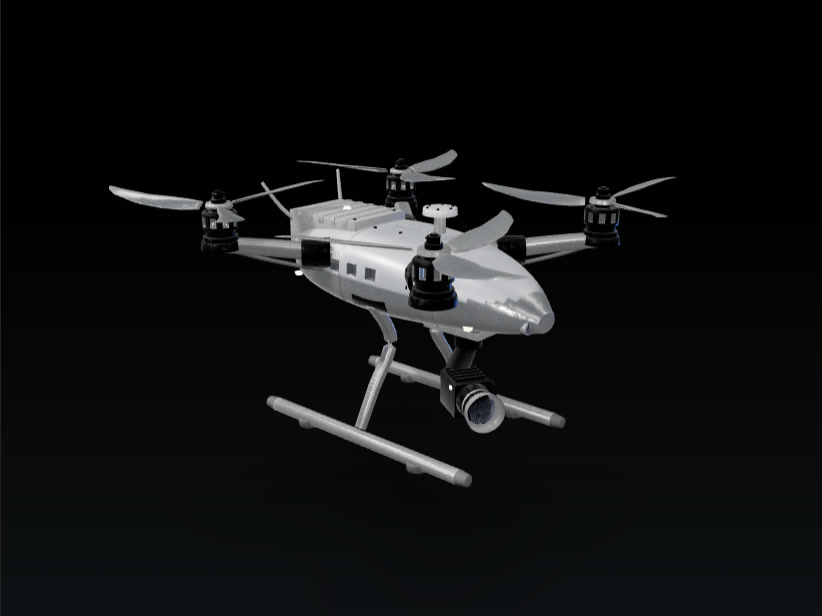
The two obsessions are finally merging: in Fall 2026 I'm launching Artificial Intelligence in Aerospace, a new organization of 25+ engineers building the Voron drone project — real airframes, digital twins, reinforcement learning, EO/IR perception, and mesh-networked flight.

Technologies

SolidWorksAnsys (FEA / Fluent)MATLABSimulinkPythonNumPy / SciPyLabVIEWGD&TReinforcement LearningRF / Mesh Networking
3.71
GPA / 4.0
$30k+
Funding Secured
40+
Engineers Led
2027
Graduating
The Exhibition

Selected Work

Three builds, documented the way they actually happened — the reasoning, the trade-offs, and what each one taught me.
SolidWorks render of the Remus ABS fuel grain showing the fluted combustion port
Fig. 1 — ABS fuel grain, fluted port · SolidWorks
Schematic of the Remus static-fire configuration: ground-side N2O tank feeding through a run valve into the horizontal motor — injector, ABS grain, and nozzle
Fig. 2 — Static-fire configuration, schematic
Exhibit 01In Development
Medium
MATLAB · Ansys Fluent · P&ID
Role
Fluid Systems Lead — NEAL Aerospace
01In Development

Remus

The injector is where the whole motor either works or doesn't.

Remus is the first motor from NEAL Aerospace, the student rocketry group I co-founded at Georgia Tech. It's a hybrid — nitrous oxide fed from a ground-side tank, through a run valve, into a 3D-printed ABS fuel grain — and it isn't a launch vehicle. It lives bolted to a test stand: the oxidizer stays on the ground beside it, and the whole point is to fire it, instrument it, and understand it. We chose the hybrid architecture deliberately, too — a hybrid can be shut off, it can't detonate the way a solid can, and it forces a small team to get genuinely good at one hard thing: moving oxidizer from a tank to a combustion chamber, on command, without leaks.

My corner of the system is everything the oxidizer touches. The injector came first: a MATLAB sizing model trading mass flow rate against pressure drop to hold a 350 psi chamber, run over and over as trade studies until the numbers stopped moving. An injector that's too soft lets chamber pressure oscillations talk back to the feed system; too stiff and you're throwing away tank pressure you paid for. When the sizing settled, I took the chamber flow into Ansys Fluent to see whether the combustion picture matched the assumptions the model was built on.

The less glamorous half of the job is the P&ID — the single drawing that names every valve, regulator, transducer, and fitting between the fill cart and the injector face. Writing it teaches you a mindset: you aren't designing for the day everything works, you're designing for the day something doesn't, and the drawing is what tells you which valve saves you.

Remus is now moving through component procurement toward cold-flow and static-fire testing on Ostia, the stand we built for exactly this purpose.

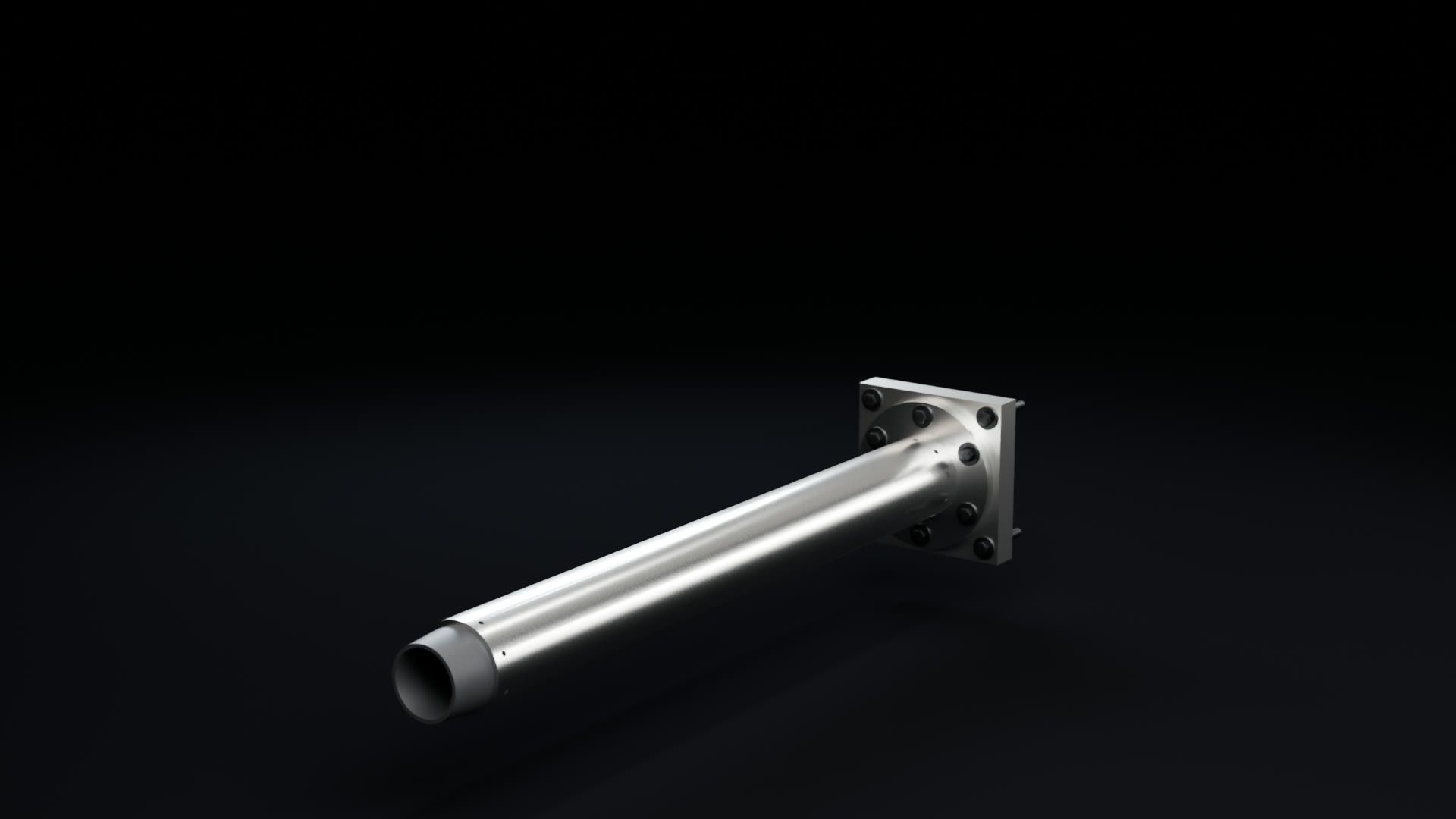
SolidWorks render of the Ostia static-fire test stand: motor tube on a linear rail with thrust plate and mounting structure
Fig. 1 — Test stand assembly · SolidWorks
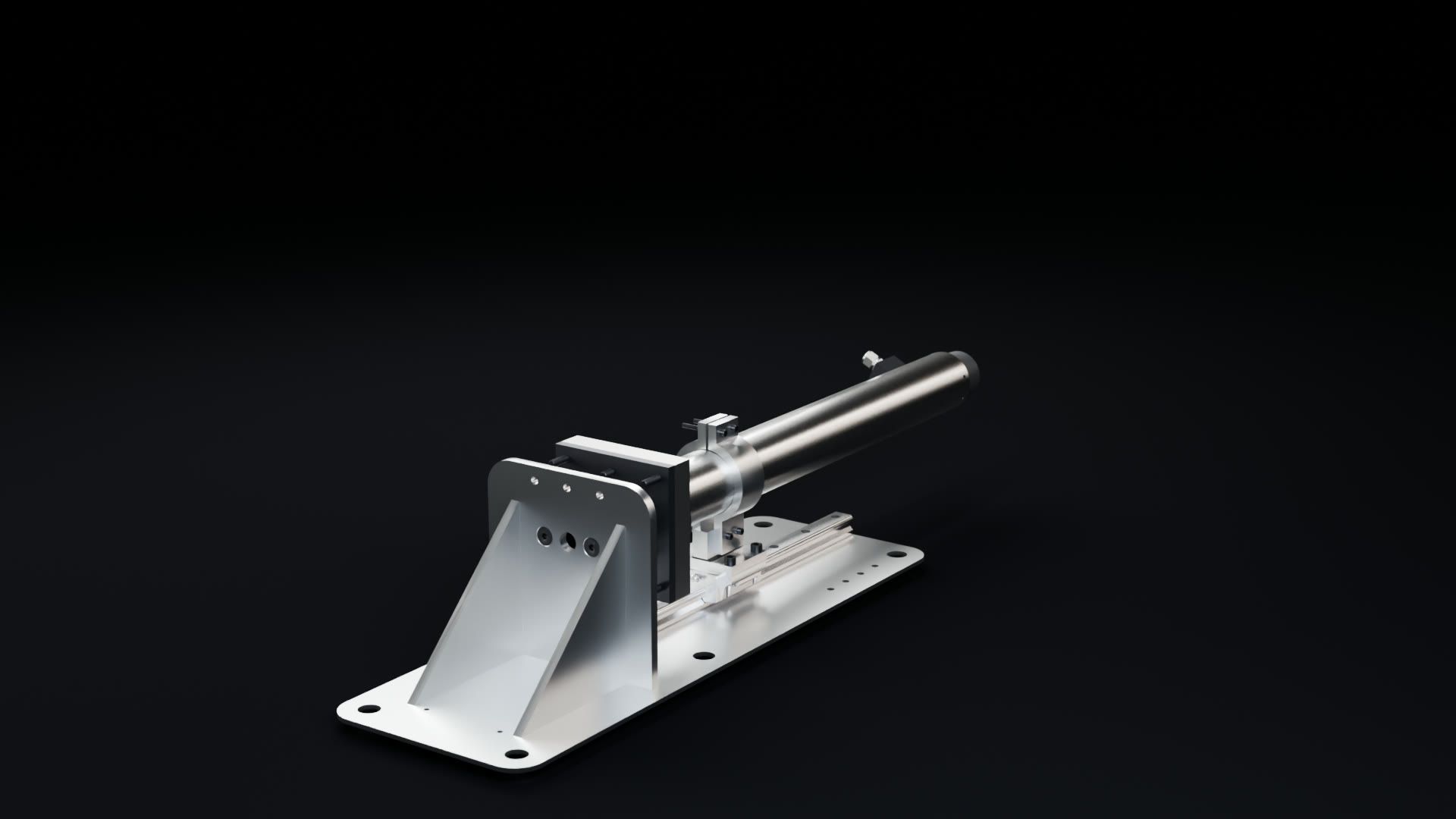
SolidWorks render of the Ostia motor mount subassembly: clamp, carriage, and linear rail on the base plate
Fig. 2 — Motor mount & rail detail
Schematic of the Ostia stand: truss frame, load cell, horizontal motor, and 1 kHz thrust trace
Fig. 3 — Instrumentation schematic
Exhibit 02Built & Validated
Medium
SolidWorks · Ansys Workbench · DAQ
Role
Structures & Instrumentation — NEAL Aerospace
02Built & Validated

Ostia

The stand exists so the rocket can fail safely — on the ground, in front of instruments.

Everything NEAL builds ends up bolted down and fired horizontally — that's the whole program. Ostia is the infrastructure that makes it possible: a modular steel static-fire stand that holds the Remus motor, absorbs the thrust, and records everything.

I designed the structure in SolidWorks around a simple demand — take 1,000 lbf of expected thrust with a 2.5 factor of safety — and then validated it in Ansys Workbench until the load paths were boring. Boring is the goal. A test stand is the one part of the program where surprise has no upside, so the frame is deliberately overbuilt steel, bolted and modular enough to be reconfigured for motors we haven't designed yet.

The other half of Ostia is its nervous system. A static fire lasts seconds, and once the smoke clears the data is the only witness. The stand carries a 2,000 lbf load cell on the thrust axis and thermocouples on the chamber, all logged at 1 kHz — fast enough to catch the ignition transient and the shape of the thrust curve, not just its peak. That data closes the loop back to the injector models: it's how a prediction becomes a measurement.

Diagram of a quadcopter wireframe following a waypoint trajectory toward a target
Fig. 1 — Policy trajectory & body axes, diagram
Exhibit 03Completed
Medium
Python · PPO · Multi-Agent Simulation
Role
Vertically Integrated Project — Autonomous Drones
03Completed

Autonomous Flight

An RL agent will find every loophole you leave in the reward function.

For a semester on Georgia Tech's Autonomous Drones VIP team, I worked on the other end of aerospace: vehicles that decide for themselves. The project trained drones to do full 3D guidance, navigation, and control in a multi-agent simulation — pathfinding through space, coordinating with teammates, and engaging targets — using PPO reinforcement learning.

The agent starts knowing nothing. No physics, no waypoints, no notion of what a target is — just observations, actions, and a reward signal. Everything it ends up doing well is something the reward function taught it, and everything it does strangely is something the reward function accidentally permitted. Most of my real work was there: tuning rewards and watching agents exploit gaps I didn't know I'd left, then closing them. It is debugging, except the bug is in your own statement of what you wanted.

That loop — specify, train, watch it misbehave, respecify — steadily improved both convergence and the maneuvers themselves. It also changed how I think about the hardware side of my work. A feed system and a reward function fail the same way: not because the design was wrong, but because the requirements were incomplete. Writing better requirements is the actual skill, and I've practiced it in two very different languages.

The VIP semester also opened a door: the following spring I joined the Aerospace Systems Design Laboratory for AFRL-sponsored multi-agent ML research — a separate project on a much larger canvas, where I built the Common Research Model framework and scenario pipeline the lab's studies run on. That work is wrapped now, but the through-line from both — simulation is only as good as its match to reality — is exactly what Voron exists to close.

Diagram of the Voron concept: a physical drone linked to its dashed digital twin by telemetry and policy arrows, above a mesh network graph
Fig. 1 — Twin loop & mesh topology, concept diagram
Exhibit 04Launching Fall 2026
Medium
RL · Digital Twins · EO/IR · Mesh Networking
Role
Founder & President — Artificial Intelligence in Aerospace
04Launching Fall 2026

Voron

Fly the real drone, update the twin, retrain the policy, fly again.

Simulation work has a ceiling: at some point the drone has to be real. That's why I'm founding Artificial Intelligence in Aerospace, a new student organization at Georgia Tech launching in Fall 2026, with a team of 25+ engineers and one flagship program — the Voron drone project. The premise is to own the entire autonomy stack ourselves, from soldering the airframe to training the policy that flies it.

The core of Voron is a loop. We build the drones from hardware up, and alongside each physical airframe we build its digital twin — a simulation model matched to the real vehicle's mass, motors, and sensors. Policies train in the simulation environment through reinforcement learning, deploy to the physical drone, and every real flight generates telemetry that feeds back into the twin, closing the gap between what the simulator believes and what the airframe actually does. Fly, measure, correct, retrain.

Perception comes from the drones' own eyes. Each vehicle carries visible-light video and infrared, and we'll train perception models on footage the fleet itself collects — EO/IR datasets of real environments rather than borrowed benchmarks, with IR extending operation into darkness and through conditions where video alone fails.

The connective tissue is the radio layer. Voron drones will talk to each other over a wireless mesh network rather than routing everything through a single ground link — every vehicle is a relay, the topology heals itself when a node drops out, and coordination degrades gracefully instead of catastrophically. Getting RF communications right is unglamorous in exactly the way P&IDs are unglamorous, which is why I suspect most teams skip it — and why we won't.

OPEN TO INTERNSHIPS — LET'S BUILD SOMETHING — OPEN TO INTERNSHIPS — LET'S BUILD SOMETHING — OPEN TO INTERNSHIPS — LET'S BUILD SOMETHING — OPEN TO INTERNSHIPS — LET'S BUILD SOMETHING — OPEN TO INTERNSHIPS — LET'S BUILD SOMETHING — OPEN TO INTERNSHIPS — LET'S BUILD SOMETHING — OPEN TO INTERNSHIPS — LET'S BUILD SOMETHING — OPEN TO INTERNSHIPS — LET'S BUILD SOMETHING — OPEN TO INTERNSHIPS — LET'S BUILD SOMETHING — OPEN TO INTERNSHIPS — LET'S BUILD SOMETHING — OPEN TO INTERNSHIPS — LET'S BUILD SOMETHING — OPEN TO INTERNSHIPS — LET'S BUILD SOMETHING —
Where I've Worked

Experience

Leadership and research roles across propulsion hardware, autonomous systems, and student life at Georgia Tech.

2024

NEAL Aerospace

Co-founder / Fluid Systems Lead

Atlanta, GA · 2024 – Present

What began as a few students who wanted to build a rocket became a 15-person engineering organization with $30,000 in funding and vendor support that I helped secure. As fluid systems lead I own the plumbing that feeds the engine — architecture, component selection, and the procedures that will govern our first static fire. Co-founding it taught me the part no class covers: making propulsion, structures, avionics, and ground support agree on interfaces before metal gets cut.

  • Feed-system architecture & P&ID design
  • Component selection & GSE integration
  • Static-fire test requirements

2024

VIP

Autonomous Drones — VIP

Vertically Integrated Projects · Fall Semester

My first pass at autonomy: a semester training PPO reinforcement-learning policies for 3D guidance, navigation, and control in a multi-agent simulation — pathfinding, coordination, and target engagement. One semester of watching agents exploit my reward functions changed how I write requirements everywhere else.

  • PPO policy training for 3D GNC
  • Reward shaping & convergence tuning
  • Multi-agent simulation

2025

ASDL Research

Undergraduate Research Assistant

Aerospace Systems Design Laboratory · 2025 – 2026

The spring after my VIP semester I joined ASDL — a separate project in the same orbit, this time AFRL-sponsored. I built the scaffolding the lab's multi-agent ML research stands on: a modular Common Research Model framework and a Python/JSON configuration pipeline, so agents trained with RL, NEAT, or DAgger could be evaluated on identical cruise-missile defense scenarios instead of one-off setups. That chapter is wrapped for now — good research infrastructure outlives the researcher.

  • Reinforcement Learning, NEAT, DAgger
  • Python / JSON scenario pipeline
  • Multi-agent simulation & analysis

2025

Georgia Tech

Resident Assistant

Georgia Tech Housing · 2025 – Present

A different kind of systems work. A residence hall of 100+ people produces incidents, conflicts, and 2 a.m. problems that no procedure fully anticipates — you learn to de-escalate, to document, and to make decisions with incomplete information while staying calm. It's the same muscle a test conductor uses, trained on humans instead of hardware.

  • Community leadership for 100+ residents
  • Conflict resolution & mentorship

2026

AI in Aerospace

Founder & President

Artificial Intelligence in Aerospace · Launching Fall 2026

Founding a new student organization built around one question: what does it take to own a drone autonomy stack end to end? I lead a team of 25+ engineers on the Voron project — building drones from hardware up, training reinforcement-learning policies against digital twins of each airframe, running perception on EO/IR video the fleet collects itself, and linking vehicles over a self-healing wireless mesh network.

  • Voron autonomous drone program — 25+ engineers
  • RL training pipeline & digital-twin simulation
  • EO/IR perception & sensor integration
  • Radio comms & mesh networking

2027

Education

BS Aerospace Engineering

Georgia Institute of Technology · GPA 3.71 / 4.0 · May 2027

2028

Education

MS Aerospace Engineering

Georgia Institute of Technology · May 2028

Expertise

Skills & Services

A hands-on toolkit spanning design, simulation, propulsion, and software — from CAD models to static-fire test data.

  • CAD & Design

    SolidWorks part & assembly design, GD&T, and design for manufacturing.

  • Simulation & Analysis

    Ansys FEA & Fluent, CFD, and MATLAB / Simulink modeling and trade studies.

  • Propulsion & Fluid Systems

    Feed-system architecture, P&ID, injector sizing, hydrostatic testing, and PDR/CDR.

  • Software & ML

    Python, NumPy, SciPy, and reinforcement learning for autonomous systems.

  • Test & Instrumentation

    LabVIEW, DAQ, load cells, thermocouples, test planning, and V&V.

  • Manufacturing

    CNC machining, lathe, waterjet, and 3D printing for rapid fabrication.